


THIS ARTICLE WAS ALSO PUBLISHED IN TAXATION MAGAZINE HERE.
Introduction
In the first part of this two part-er, I looked at BW’s remuneration trusts and the type of loans provided by the trustees of such arrangements. This line of cases has shown that, despite HMRC’s protestations, that the decision in Rangers has its limitations when it comes to owner-managers and s62 of ITEPA 2003.
However, bearing in mind that the tribunals have clarified that the meaning of ‘in connection with’ for Part 7A is a wide one, and that these ‘disguised remuneration provisions have been found to apply now across a number of cases, then this is the very definition of a pyrrhic victory.
In this part, I look at the case of The Executors of Mrs Leslie Vivienne Elborne Deceased & Anors v HMRC(“Elborne”)[1]. A case that also deals with an old tax planning scheme using debt. In other words, the IHT home loan scheme.
Once again, Judge Zaman was one of the judges in the UT instalment of the Elborne. Again, the tribunal found in favour of the taxpayer and rejected the analysis of the FTT.
Let’s take a look behind the curtain.
Background
General
The Elborne case is a classic “home loan” double-trust scheme used to mitigate inheritance tax (IHT) on the family home.
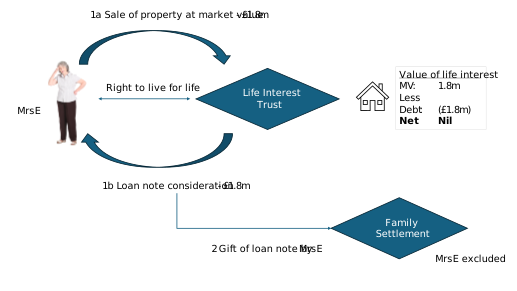
As it says on the tin, this involved setting up two trusts. In the Elborne case, this was as follows:
Trust 1 – The Life Settlement
On 27 November 2003:
- Mrs Elborne (“Mrs E”) created a life interest trust in which she herself was the life tenant (entitled to occupy or enjoy the trust property for life);
- On the same day, she sold her home (the Old Rectory) to the trustees of this life interest trust for its full market value (£1.8 million).
- As the trustees had no cash, the purchase price was satisfied by the trust issuing a £1.8 million promissory note (loan note) in favour of Mrs E.
The trust’s trustees formally resolved to allow Mrs E to continue residing in the property rent-free for life, consistent with her life interest. Indeed, she remained in her home and paid all usual outgoings until her death.
Trust 2 – Family Settlement
On 8 December 2003:
- Mrs E established the Family Settlement for the benefit of her three adult children (excluding herself from any benefit);
- She immediately assigned the £1.8 million promissory note to the family trust as a gift, for no consideration. This transfer of the loan note was a potentially exempt transfer (PET) for IHT purposes;
Mrs E survived for more than seven years after making the gift (she died on 6 January 2011), so the PET of the loan note fell outside her estate on death.
The overall intended effect was that, at the time of Mrs E’s death, her home would still be valued in her estate (via the life interest), but the value would be reduced by the outstanding debt the life interest trust owed under the £1.8 million note.
In substance, the value of the house was supposed to be offset by an equivalent liability, leaving little or no taxable estate attributable to the home.
Crucially, to avoid an income tax charge under the lesser-spotted Pre-Owned Assets Tax (POAT) rules[2], while continuing to live in the home, Mrs E made the special paragraph 21(2) election.
The effect of this was that the property was treated as subject to a reservation of benefit to the extent she was not already treated as owning it via her life interest.
This election essentially acknowledged that if at any point she ceased to have a life interest, the arrangement would be treated as a gift with reservation (“GWR”) for IHT, thereby exempting her from POAT charges on imputed rent.
As long as she retained a qualifying life interest, the home was in any event included in her estate under IHTA 1984, s49, and POAT did not apply.
Mrs E passed away in January 2011, by which time the scheme had been in place over seven years. On her death, the life interest trust still owned the house and still owed the £1.8 m note (no repayment had been made in the interim).
Her executors valued the house for IHT but claimed a deduction for the £1.8 million liability owed to the family trust, arguing that the estate’s value should be reduced accordingly.
Essentially, the estate included the house net of the debt.
HMRC disagreed and refused the deduction, contending that anti-avoidance provisions prevented the loan liability from reducing the estate.
So, it was off to the tribunal.
Illustration
First-Tier Tribunal (“FTT”)
The FTT,[3] as it had done in the similar case of Pride[4], agreed with HMRC’s position that the scheme did not work.
It held that when calculating the value of Mrs E’s estate, the £1.8 million liability under the promissory note had to be “abated to nil” under the anti-avoidance provision at s103 of FA 1986.
This provision targets certain artificial debts or encumbrances created to reduce one’s estate value.
In essence, it provides that if a liability was incurred by the deceased and the consideration for that liability was “property derived from the deceased,” then the liability is disregarded (or proportionally reduced) when valuing the estate.
The FTT found those conditions satisfied here. It reasoned that the loan note was an encumbrance created by Mrs E’s own disposition of her property (she disposed of the house to the trust and caused the trust’s debt to herself).
Therefore, even though the note was formally a debt of the trust, the FTT treated it as a “debt incurred by the deceased” for purposes of s103.
Furthermore, the FTT noted that the consideration for the debt – the promissory note – was given in exchange for Mrs E’s house. In other words, it was funded by “property derived from the deceased.” The entire value of the loan note was directly attributable to the property she herself transferred.
Under s103(1)(a) and (3), this meant the liability should be abated in full (reduced 100%) because the consideration for it was entirely the deceased’s own property.
In practical terms, the FTT held that the £1.8 m debt could not be deducted from the Old Rectory’s value in Mrs E’s estate.
As such, the scheme was deemed ineffective with the house remaining fully exposed to IHT.
Upper Tribunal (“UT”)
General
Mrs E’s executors appealed to the UT. The main issue for them was this ruling on s103 as this represented the sole defeat among several issues, with the FTT rejecting a number of other HMRC arguments.
I will come to these below, but, for now, HMRC cross-appealed five of those previously rejected points.
The focus of the UT was the s103 question. Essentially, whether the anti-avoidance rule applied to negate the loan liability.
Debt “incurred by the deceased.”
The main question was whether the promissory note liability could be considered a debt “incurred by” Mrs E.
The UT disagreed with the FTT’s reasoning that a trust’s liability automatically counted as the life tenant’s own debt.
The judges noted that IHTA 1984, s49(1) deems a life tenant to be beneficially entitled to the trust property for estate valuation, but “we are not persuaded that the deeming in s49(1) requires that the holder of the interest in possession be treated as personally liable for the debts of the settlement.”
In other words, the liabilities of the trust are not the personal liabilities of the deceased. Mrs E did not borrow £1.8 m; rather, she extended credit to the trust (the trust owed her).
The UT held that the loan note was a debt incurred by the trustees, and nothing in s103 re-characterises it as a debt of the deceased herself.
Thus, a fundamental precondition of s103 was not satisfied. In other words, the note was not a “debt incurred by the deceased,” so s103 should never have been invoked.
This eliminated the main basis on which the FTT had nullified the liability.
“Property derived from the deceased.”
Although not strictly necessary (given the above finding), the UT also examined HMRC’s argument that the consideration for the debt was “property derived from the deceased” (another element of s103).
HMRC pointed out that the trust issued the £1.8m note in exchange for Mrs E’s house, which wa obviously her property.
The UT, however, construed s103 more narrowly.
The statute requires identifying the consideration given for the debt, and determining if that consideration came from the deceased.
Here, the direct consideration for the trust’s debt (the note) was the transfer of the house to the trust. That transfer was certainly made by Mrs E.
However, the UT noted that s103(1) contemplates a scenario with two transactions:
- a disposition by the deceased; and
- the incurring of a debt, where the consideration for the debt is the property from that disposition.
In Mrs E’s case, those events were effectively simultaneous parts of one integrated sale.
The UT was unwilling to treat the house transfer as “consideration” in the sense intended by s103, since the section’s purpose is to catch artificial debt schemes involving recycling of the deceased’s assets.
The UT hinted that s103 is aimed at cases with a circular exchange. For example, a person mortgages their own property to create a debt and “gift” cash to someone, essentially creating a debt funded by their own property.
By contrast, in this case, Mrs E genuinely sold her house for full value. It just so happened the value was paid by note instead of cash.
The UT concluded that applying s103 to nullify the note would “thwart the clear statutory purpose” of IHT provisions like s49, which include such life interest transfers in the estate net of liabilities.
Consequently, the UT also rejected the “property derived from the deceased” argument, finding that s103 did not envision disregarding a liability in these circumstances.
HMRC’s cross-appeals on other issues
So, let’s look at those cross-appeals now referred to above.
In summary, the UT also dismissed all five grounds of HMRC’s cross-appeal, which challenged the FTT’s previous ‘pro-taxpayer’ findings on ancillary points. In brief, there were:
| Gift with Reservation (GWR) | The arguments were refused.
HMRC had contended that Mrs E’s arrangements fell foul of the GWR rules (FA 1986, ss102 and 102A) either in respect of the house or the loan note.
The UT disagreed, noting that because Mrs E retained a life interest in the entire property, the situation was already fully taxed under s49 IHTA with “property subject to a qualifying interest in possession cannot simultaneously be subject to a reservation of benefit.”
Likewise, the gift of the loan note to the children’s trust was not coupled with any benefit to her from that note. Her continued occupation of the house was by virtue of the life interest, not by virtue of anything she did with the note.
Therefore, the loan note gift was not caught by GWR (it was a genuine gift with no strings attached).
The 2006 POAT election was found not to prejudice her position either, it was a prudent defensive measure that did not, in the UT’s view, turn the arrangement into a disqualifying reservation of benefit |
| Ramsay / Hurstwood | The UT also rejected HMRC’s reliance on modern anti-avoidance case law including the Ramsay[5] principle as reiterated in HMRC v Hurstwood Properties (Rossendale) Ltd[6]
HMRC argued that the loan note was a classic “element of a transaction which has no business purpose…with the sole aim of avoiding tax,” and thus should be disregarded in a purposive construction of the IHT statutes
The UT was not convinced that a broad Ramsay approach overrode the specific language of the IHT provisions in this context.
It noted that Parliament had enacted targeted rules (like s103 and the later s175A) to address such schemes.
Where those rules did not exactly bite (as here), the court hesitated to invent a further anti-avoidance result purely from general principles.
In effect, the UT upheld the sanctity of the statutory conditions: if they are not met, the taxpayer’s arrangement, however tax-motivated, remains effective. |
| Post 2013 rules on liabilities | Finally, the UT confirmed that the executors had navigated the post-2013 IHT rules, requiring that liabilities must actually be repaid out of the estate to be deductible.
In Mrs E’s case, this was not directly at issue because her death in January 2011 pre-dated that rule.
Nevertheless, it is noted that upon Mrs E’s death, the house was sold and the sale proceeds were used by the life trust to repay the £1.8m note to the family trust, thereby ensuring no unpaid debt remained.
Thus even under current law, the liability was discharged from the estate.
HMRC’s attempt to find any technical non-compliance failed with the UT agreeing with the FTT that no further obstacles (such as double-counting or formality issues) prevented the deduction of the note.
|
The conclusion of all of this was that the UT set aside the FTT’s decision on the s103 issue and re-made the decision in the executors’ favour, allowing the full deduction of the £1.8 million liability.
Does this matter?
Of course, the decision directly matters to the Elborne family and those who have entered into this type of planning. For now, see below, the scheme has been found to work.
Like Currell, covered in the first article, the legislative position has moved on so the double trust home loan scheme could not work now (mainly due to the IHT changes in 2006). In addition, from 2011, DOTAS has also applied for IHT purposes and one would also need to consider GAAR.
However, the transfer of assets to family investment companies and other structures with that loan note / promissory note subsequently gifted is a relatively well trodden path. This ruling, again, subject to any appeal, might provide some clarification of the issues.
Conclusion
Even as far back as 2011, HMRC publicly and confidently asserted that home loan schemes did not work[7].
As such, it is a blow to HMRC that the tribunal has found that it did, in fact, work.
However, based that this was a relatively common IHT arrangement, and there is potentially a significant amount of tax at stake, it is not surprising that HMRC has applied to appeal this decision to the Court of Appeal[8].
As such, it feels as thought here is drama yet to come. But for now, it’s HMRC nursing the bruises, and very much left to reflect that home (loan) is where the hurt is.
[1] The Executors of Mrs Leslie Vivienne Elborne Deceased & Anors v HMRC [2025] UKUT 00059 (TCC)
[2] Finance Act 2004, Sch 15
[3] Executors of Elborne & Ors [2023] UKFTT 626
[4] Pride (as trustee of the estate of the late Pride) [2023] UKFTT 316 (TC)
[5] WT Ramsay Ltd v IRC [1982] AC 300, (1981) 54 TC 101
[6] HMRC v Hurstwood Properties (Rossendale) Ltd [2021] UKSC 16).
[7] For example, in October 2010, HMRC updated their POAT guidance notes in relation to lifetime ‘double trust/home loan’ schemes
[8] See case reference CA-2025-001355