


THIS ARTICLE WAS ALSO PUBLISHED IN TAXATION MAGAZINE HERE.
INTRODUCTION
When I first started writing this article, I was going to look at two quite different tax schemes which had some interesting similarities. The cases were MR Curell v HMRC[1] (“Currell”), a Baxendale-Walker (“BW”) remuneration trust and The Executors of Mrs Leslie Vivienne Elborne Deceased & Anors v HMRC(“Elborne”)[2] , an IHT home loan scheme.
Different schemes, both with loans, but in both cases the taxpayer had secured victories in the Upper Tribunal with a common judge in each case.
However, before submission, the Court of Appeal (rather inconveniently!) published its judgment in Marlborough DP v HMRC[3] (“Marlborough”). Broadly, this involved substantially the same structure as in M R Currell, yet the result, at first glance, appears a little different.
As such, I got distracted and started to consider what a comparison of these two BW schemes tells us, if anything.
I will return to Elborne in the second of this two part article and look at what that tells us about the home loan scheme and other estate and IHT planning plays. So, you can breathe a sigh of relief.
M R CURRELL v HMRC
Background
M R Currell Ltd (the Company) was, and appears to still be, a family-owned painting and decorating company. A pretty ordinary, though reasonably successful, family business. What makes it noteworthy for this article was its decision, back in November 2010, to implement an employee benefit trust (“EBT”).
The company contributed £800k to the EBT. Shortly afterwards, Mr Currell (Mr C), who was a director-shareholder of the Company, applied to the EBT for a loan of £800k, The purpose of which was to purchase A Ordinary Shares in the Company from his wife, Mrs Currell (Mrs C).
The Trustees approved a five year, interest-free loan of £800k to Mr Currell. The purpose of the loan was to purchase of the shares from Mrs C.
Mrs C loaned back the £800k to the company which was repayable on demand.
Throughout, Mr C continued to draw his normal salary and dividends from the company in subsequent years, indicating the £800k, indicating that the arrangement was not a substitution for his regular remuneration. .
Illustration
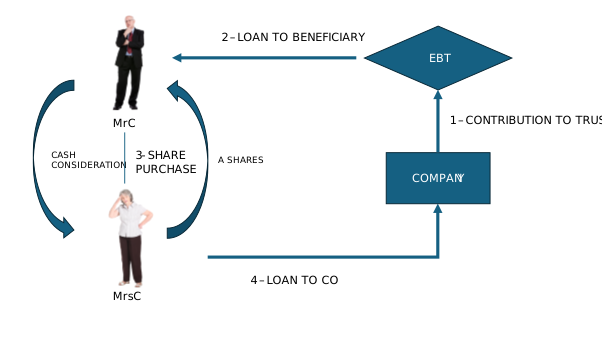
As such, the end point was that Mrs C had sold her shares to Mr C with the proceeds she received wending their merry way back to the Company. Mr C owed money to the trustees under the loan.
First-tier Tribunal (“FTT”)
HMRC issued determinations in 2015 under Regulation 80 of the PAYE Regulations 2003 and under s8 of the Social Security Contributions (Transfer of Functions) Act 1999.
These asserted that the £800k contributed to the EBT was in substance a reward for Mr C’s services and therefore subject to PAYE.
The Company appealed, but the FTT dismissed the appeal in July 2023.
The FTT found that the £800k payment to the EBT constituted earnings of Mr C within the meaning of ITEPA 2003, s62, which defines “earnings” to include “any gratuity or other profit or incidental benefit of any kind obtained by the employee, if it is money or money’s worth.”
The FTT concluded that The Company’s contribution (and the ensuing loan) was a profit or benefit obtained by Mr C by reason of his employment, essentially a disguised bonus rewarding his services.
A notable point of confusion at the FTT was whether the taxable “earnings” were represented by the company’s contribution to the trust or by the loan received by Mr C.
The FTT’s decision referred ambiguously to “it” as the amount treated as earnings, but ultimately the tribunal seemed to view the company’s £800k payment into the trust (pre-wired to provide Mr C with the loan) as the taxable event. It reasoned that The Company’s payment was made as part of a plan to benefit Mr. Currell (the only employee to receive a loan), and thus the payment was effectively remuneration for him.
The tribunal was prepared to treat a loan as a taxable benefit in the “vast majority of cases,” on the view that providing an employee with spendable cash (even via a loan) confers a benefit akin to pay.
Upper Tribunal (“UT”)
The Company appealed to the UT, arguing that the FTT had erred in law by mischaracterising the arrangement as taxable earnings.
The UT agreed with the Company, and set aside the FTT’s decision for error of law, holding that the transactions did not give rise to taxable earnings.
The UT found that the FTT had over-generalised the treatment of loans, failing to examine the true character of this particular payment and loan. Simply because a payment was made in connection with an employee did not automatically render it “earnings.”
Instead, the UT emphasised that one must ask “what was the payment for?”.
In this case, The Company’s contribution was made to facilitate Mr C’s share purchase, not to discharge any pre-existing entitlement to salary or bonus.
Notably, Mr C had no contractual or expected bonus of £800k; in fact, the Company continued paying normal bonuses to employees (including Mr C) in subsequent years, indicating the EBT loan was in addition to ordinary remuneration.
Moreover, Mr C was obligated to repay the £800k to the trust, and he did not have unfettered use of the money for personal enjoyment as it was used to acquire shares and ultimately circulated back into the company via his wife.
These facts convinced the UT that the “character” of what Mr. Currell received was a genuine loan, not a payment of earnings.
Importantly, the UT distinguished the facts from the landmark Rangers[4] football club EBT case.
In Rangers, a series of trust loans to employees had been found to be taxable remuneration. However, the UT noted a critical difference in that, in Rangers, it was effectively agreed or assumed that the trust contributions were bonuses. The employees had an expectation of those sums and the loans were not genuinely expected to be repaid.
By contrast, in Currell, Mr C had no automatic entitlement to an £800k reward and there was a real expectation of repayment (albeit long-term).
The UT rejected HMRC’s contention that Rangers provided a “straightforward” rule that any payment via a third-party trust is taxable earnings. The proper approach is fact-specific with a payment connected to employment only being earnings if it is truly a reward for services.
The UT also found the FTT had misapplied ITEPA 2003 s.62(2)(b). The tribunal should not assume that an interest-free loan automatically counts as a “profit or benefit” to the employee if that loan must be repaid. In the UT’s view, the obligation to repay “overrides any benefit” he obtained from the loan.
MARLBOROUGH DP v HMRC
Background
The taxpayer was a dentist, Dr Thomas, who operated as a limited company, Marlborough DP Limited (MDPL).
He entered into a scheme with BW along the same lines as the one described above. It should be noted for the purposes of this tribunal, MDPL accepted that the payments should have been taxable as distributions.
The FTT / UT
General earnings
Again, the first issue for the FTT[5] to consider was what was the source of the payment and whether it was ‘from’ Dr Thomas’ employment.
The taxpayer argued that neither the contributions or the loans were made as a reward for Dr Thomas’ services. Instead, they were paid in respect of his shareholding in MDPL.
HMRC argued that the payments must “represent the fruits of Dr Thomas’ work for MDPL. Once again, they served up Rangers as the knock-out punch.
However, the FTT determined that the payment to the trust, and the subsequent loans, had come ‘from’ the Dr Thomas’ capacity as a shareholder:
“We note the following:
(1) There was no contractual obligation on MDPL to pay the sums as a reward for Dr Thomas’ services as director/dentist and there is nothing in any of the documents or evidence to suggest that that was the reason for the extraction of MDPL’s funds into Dr Thomas’ hands.
(2) The sums paid to Dr Thomas comprised the totality of the overall profits of MDPL’s business, as computed after the deduction of expenses, such as salaries paid to those employed by MDPL including the relatively small salary paid to Dr Thomas and, accordingly they were paid out sporadically.
(3) Dr Thomas’ evidence was that, had those profits not been routed through the RT arrangements, they would have been paid to him by way of dividend and not as salary.”
As such, the case again demonstrated the limitations to the Ranger’s decision.
On appeal, regarding this point, the UT accepted that this was an evaluative judgment that the tribunal was entitled to come to and the decision was left undisturbed.
The Part 7A issue
The second issue, one not present in Currell, was whether the Part 7A of ITEPA 2003 applied.
This issue could largely be distilled into interpreting the meaning of “in connection with” in ITEPA 2003, s554A(c):
(c)it is reasonable to suppose that, in essence–
(i)the relevant arrangement, or
(ii)the relevant arrangement so far as it covers or relates to A,
is (wholly or partly) a means of providing, or is otherwise concerned (wholly or partly) with the provision of, rewards or recognition or loans in connection with A’s employment, or former or prospective employment, with B,
It was the FTT’s view that, for there to be a “connection” of the required kind with Dr Thomas’ employment, the employment must be part of the reason for the reward, recognition or loan.
On that basis, the FTT stated that this required essentially the same analysis as that set out in relation to whether the relevant sums constitute earnings. Unsurprisingly, on that basis, the FTT therefore came to a similar result and that Part 7A did not apply.
But was that the right basis?
The FTT’s decision making in this aspect of Marlborough was rejected by the FTT in two other BW cases, Strategic Branding Limited v HMRC[6] & CIA Insurance Services Limited v HMRC[7] (both heard by Judge Zaman).
With this in mind, it is perhaps no surprise that the UT upheld HMRC’s very appeal on this point and that the FTT had erred by using the wrong test.
The UT made several points about this [para 144 onwards]:
- it poses an objective test (“it is reasonable to suppose that”)
- it is drafted in expansive terms and is intended to catch a wide range of arrangements, often involving third parties e.g. trust and other entities, whereby benefits (to use a convenient but non-statutory term) are provided “in connection with” an employment.
- Parliament chose the phrase “in connection with…employment” in preference to the time-honoured “from an employment” found in the legislation relating to general earnings or “by reason of” employment to give it a wider scope than the charge to income tax on general earnings.
As such, it follows that a loan may be provided in connection with an employment even though it is not “from” an employment.
It may feel that the distinction is the equivalent to dancing on the head of a pin. However, the UT helpfully sat out an example, which I elaborate on here:
Hochstrasser v Mayes [1959] 38 TC 673
Mr Mayes was employed by ICI and was transferred by his employer from one part of the UK to another for work reasons. As part of its staff relocation support, ICI operated a housing loss reimbursement scheme. Under this scheme:
- If an employee had to sell their home at a loss due to a work-related transfer, the employer would reimburse the difference between the purchase and sale price.
- Before receiving this reimbursement, the employee had to first offer the property to ICI at its current market value.
Mr Mayes sold his house at a loss and claimed the difference from ICI under this scheme. HMRC (then the Inland Revenue) assessed this payment as taxable emoluments, essentially employment income, arguing it arose “from” the employment.
The key question was whether the payment taxable as a profit or emolument “from” employment, or was it a capital sum or personal compensation, and therefore not taxable?
The Court of Appeal held in favour of Mr Mayes. They found that:
- The payment did not arise “from” his employment, even though he wouldn’t have received it “but for” being an employee.
- The payment was intended to indemnify him against a personal financial loss he incurred in selling his house at a loss when relocating.
- It was not a reward for services or a benefit arising out of performing duties, but rather a reimbursement for a capital loss caused by a work-related transfer.
In summary, “from employment” implies a causal link between the payment and the employee’s services or duties. It is a payment made as a reward or remuneration for work.
In contrast, “but for” employment refers to situations where the payment would not have arisen had the person not been employed, but it does not arise because of the duties performed. The employment is a condition of eligibility, but not the cause of the payment.
In Hochstrasser v Mayes, it was decided that it was the latter with the payment being related to his status as a house owner affected by relocation, not his function or reward as an employee.
As such, one might argue that, in the context of Part 7A, Mr Mayes, although he did not receive the payment “from” his employment, did receive it ‘in connection with’ his employment.
The UT were at pains to point out that, despite being drawn widely, it did not have limitless reach. Following on from the decision in London Luton Hotel BPRA Property Fund LLP v HMRC[8], which considered the meaning of “in connection with” in the context of BPRA, the UT stated that there must be a “strong and close nexus”.
As such, the next step was to consider whether there was such a nexus in the present case.
The UT found that there was. This was on the basis that [see para 150]:
- The profits of MDPL, paid as contributions to the RT and then on-lent to Dr Thomas, reflected the profits of the dental practice carried on by MDPL.
- Dr Thomas was actively engaged in the practice as a dentist and was assisted by a hygienist and an associate dentist;
- At all material times, Dr Thomas was the sole director of MDPL and, therefore, the guiding mind of the company solely responsible for the conduct and direction of its business from which the profits were derived.
On this basis, the UT concluded that there was a sufficiently direct and close connection with Dr Thomas’ directorship to trigger that section 554A(1)(c) and that this reflected the essence of the overall arrangement.
The Court of Appeal
Marlborough subsequently appealed to the Court of Appeal. However, for sake of time, they concluded that the UT reached its conclusions properly based on the facts.
BACK TO CURRELL
Overview
But what of Currell? If this was done in a post Part 7A world, would it suffer the same fate as Marlborough?
Application of the Marlborough test to Currell
The question is how fact dependent was the decision in Marlborough?
As set out above, the FTT applied the wrong test and, as such, perhaps did not necessarily tease out all of the relevant factors. The UT had to apply the facts as determined by the FTT using the correct test.
That said, following on from the UT’s Marlborough analysis above (with which the Court of Appeal has no qualms), my view would be that they would likely find a sufficiently strong and close nexus between the payment of the loan and the Mr C’s employment.
Indeed, looking at Judge Zaman’s decisions in both Strategic Branding Limited and CIA Insurance Services Limited, it seems likely that she would have agreed with the decisions of the UT and COA in Marlborough and that Part 7A was engaged.
But this then leads us to question was the extension of Part 7A to ‘close companies’ (the s554AA gateway) from April 2018 ever necessary? As the reader might be aware, this extended Part 7A for arrangements such as split contracts, where the shareholder / director received loans in respect of services provided as a self-employed consultant. Undoubtedly, Currell would be caught by this Close Company gateway at the very latest.
Was this simply a case of the government clarifying the position and putting “beyond doubt when Part 7A applies to the remuneration of owners of close companies.”[9] Or could some cases still pass through eye of the needle between the original enactment of Part 7A and the introduction of the Close Company gateway in April 2018?[10]
What if the trustees simply acquired the shares?
Interestingly, rather than making a loan to Mr C, what if the trustees had simply purchased the shares from Mrs C and then Mrs C then loaned back the funds to the Company? Of course, the end result here is slightly different as the shares end up in the trust.
Here, assuming there was no tax avoidance motive, and all took place on market terms, the value of the relevant step would be reduced by the value of consideration paid under ITEPA 2003, s554Z8.
There would appear to be no tax liability under Part 7A.
CONCLUSION
Both cases show the limits to the Rangers decision when it comes to what constitute earnings under ITEPA 2003, s62 and particularly where there are shareholder / directors involved.
Of course, the Currell transactions pre-date the post-disguised remuneration rules so the relevance is largely historic and represents a bit of a pyrrhic victory for BW (the payments should have been taxed as distributions in any event).
Marlborough shows how Part 7A, with its wider test of ‘connection’ has substantially bolstered the general earnings rule.
It appears the changes to Part 7A, to explicitly bring in ‘close company’ transactions, were perhaps superfluous.
In addition, it has to be said that both cases are ones that, if not precisely covered by an existing GAAR advisory panel decision, would likely, in my opinion, be found to fall foul of GAAR.
“Dickens began with ‘It was the best of times, it was the worst of times.’ This tale ends simply: it appears to be the end of the times… at least for the hopes of BW scheme users.”
[1] MR Currell Ltd v HMRC [2024] UKUT 00404
[2] The Executors of Mrs Leslie Vivienne Elborne Deceased & Anors v HMRC [2025] UKUT 00059 (TCC)
[3] Marlborough DP v HMRC [2025] EWCA Civ 796
[4] RFC 2012 Plc v Advocate General [2017] UKSC 45
[5] Marlborough DP Ltd v Revenue and Customs Commissioners [2021] UKFTT 304 (TC)
[6] Strategic Branding Limited v HMRC TC/2018/06099; TC/2018/06613
[7] CIA Insurance Services Limited v HMRC TC/2018/01518
[8] The London Luton Hotel BPRA Property Fund LLP EWCA Civ 362
[9] https://www.gov.uk/government/publications/draft-legislation-tackling-disguised-remuneration-avoidance-schemes/tackling-disguised-remuneration-technical-note
[10] I appreciate that I might be the only person in the world interested in this answer!