

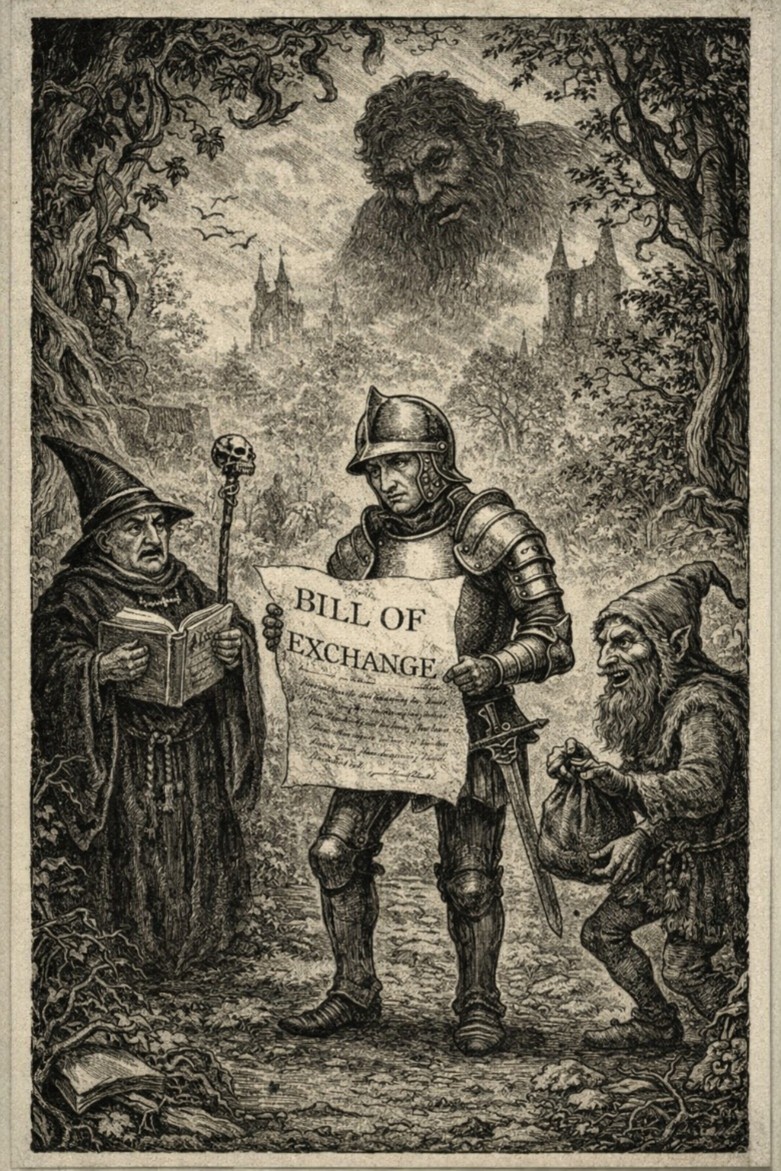
This article was kindly published by Taxation Magazine in full on Tuesday 17 March 2026
Prologue
Once upon a time there was a salesman.
Let’s call him Rumpelstiltskin. He had a sales pitch. It went a little something like this:
“You have some tax debts? You don’t need to use real money to settle it. Use a “Bill of Exchange.”
We can create such a document that draws on a secret fund, and is created at your birth and held, apparently, by the State. The creditor hasto accept the payment.
What a wheeze, eh? Certainly, more lucrative than spinning straw into gold”
Broadly speaking, the Bills of Exchange in this context are tantamount to holding a bag of Magic Beans. But without the magic. There’ll be no beanstalk, no goose or golden eggs … and don’t think for a minute that, on encountering severe buyer’s remorse, you’ll be getting that cow back either.
This is a tale so dark and twisted it is be-fitting of the Brothers Grimm. And I mean the dark, non-Disney versions.
So, are you sitting comfortably?
Well, the narrator of this tale first came across this ‘product’, a couple of years ago, in the context of SDLT “planning”.
More recently, I’ve seen it wandering, with (sadly) some speed, into the umbrella company world, where there is a clear and present danger of it creating compound tax carnage.
So, what is this thing, why is it bobbins, and why is it likely to be even more toxic from April this year?
Chapter 1: The “Magic Trust” in a kingdom far away
We gave the US the Beatles and the Rolling Stones. They have given us tariffs… and the foundations of this advanced fee, confidence trick.
So, let us start in the US and, for a bit of theatre, let’s start at the US Treasury. Their own anti-fraud material[1] describes the “Bills of Exchange drawn on the Treasury” scam in pretty blunt terms:
The Story
… When the United States went off the gold standard in 1933, the federal government somehow went bankrupt.
With the help of the Federal Reserve Bank, the government converted the bodies of its citizens into capital value, supposedly by trading the birth certificates of U.S. citizens on the open market. … each citizen is entitled to redeem his or her “value” by filling out a sight draft drawn on their (non-existent) TreasuryDirect account.
The scheme asserts that each citizen’s Social Security Number is also his or her account number. As a part of the scheme, participants also file false IRS Forms 8300 and Currency Transaction Reports in the name of law enforcement officials and other individuals they seek to harass.
The Reality
Drawing such drafts on the U.S. Treasury is fraudulent and a violation of federal law. The theory behind their use is bogus and incomprehensible. The Justice Department is vigorously prosecuting these crimes…
A Note on Bills of Exchange
With early and vigorous prosecution by the Justice Department on bogus Sight Draft cases, we have begun to see Bills of Exchange taking their place… This is the same fraud under another name.
So, we can see that the so-called ‘sight draft’ fraud became the same scam under the bills of exchange name.
Chapter 2: The magic trust spreads its wings
But that’s the US right? They have maple syrup on bacon. Surely, this couldn’t happen in the UK? Or could it?
Well, it already has. The ‘arrangement’ discussed in the remainder of this article is essentially a UK version, with one or two cosmetic tweaks.
Let’s hear about the magic trust from the promoter:
THE PRIVATE-PUBLIC TRUST
The registration of your birth creates an asset: a paper/electronic security, performing over time, a mirror image of you with a name so similar you do not notice. The more assets the State has, the more it can borrow from its Central Bank, with those assets being the security for the debt.
Obtaining a copy of your birth certificate from the GRO can enable you to find a security identification number relating to you on the international securities exchanges.
There is a trust relationship here and because you did not know your status as the source/sponsor of the credit and principal beneficiary of the trust identified by your name, you are presumed to be the trustee of the trust, responsible for settling all liabilities relating to your name.
However, if one understands that the registration of your birth created the trust and that you are the beneficiary of the funds held on that trust’s account, then you can properly appoint trustees in public office to settle your trust’s liabilities.
So, the story is slightly different. There is no government bankruptcy connected to the creation of the trust in this version of the fairytale. However, it is still your birth that creates the magic fund that you can dip in and out of(!)
Lo and behold, the UK Treasury dismissed this barmy idea back in 2019
“[The] Treasury has been receiving correspondence concerning Notice of Claim, or Notice of Intention of household bills stamped “exempt from levy” attempting to pay bills using a National Insurance Number or Birth Certificate.
Treasury do not hold accounts under birth certificates. The registration of a birth under the provisions of the Births and Deaths Registration Act 1953 is simply a recording of the event (that is, the birth) that took place, and does not involve the creation of a bond, stock or trust.”[2]
But, let’s get back to the Promoters spiel shall we:
“If we remember that the credit system has been decoupled from real money of substance, that banks create money from nothing by lending, and that the actual value backing the credit of nations is the value of the people, then we can see that there is a circularity involved between the people being the ultimate creditors of the entire system and at the same time their estates being construed to be the debtors of the credit issued.”
Granted, a fine word salad. But it’s far from being fine law.
We then have some legal authority for this plan thrown at us. From the indomitable Lord Denning no less [9]:
“We have repeatedly said in this court that a bill of exchange or a promissory note is to be treated as cash. It is to be honoured unless there is some good reason to the contrary.”
~ per Lord Denning M.R. in Fielding & Platt Ltd v Selim Najjar [1969] 1 W.L.R. 357 at 361; [1969] 2 All E.R. 150 at 152.
We can’t argue with Denning, surely?
But it’s difficult to see how a quote could be taken any more out of context than this one.
The quote is used by the Promoter to demonstrate some judicial authority that the ‘cheque’ is to be treated as if it is cash. As such, the recipient must accept it in settlement of the debt.
But, of course, this isn’t what he was saying. In fact, I suggest, Lord Denning was saying precisely the opposite.
What he was saying in that passage is that if a debtor provides a bill of exchange or a promissory note to a creditor, it is binding on the debtor. In other words, the debtor (person making out the cheque) must honour the cheque unless there is a good reason why not.
Importantly, a bill of exchange will only extinguish an existing debt if the creditor agrees with that mechanism of payment. Of course, a creditor is always entitled to insist on payment in legal tender.
A creditor need no more accept a bill of exchange than he or she must accept a payment in magic beans.
It is also worth reminding ourselves what a bill of exchange actually is in orthodox commercial law. It is an unconditional order by one person (the drawer) directing another (the drawee) to pay a specified sum to a third party. For it to function, there must be a real drawee capable of accepting and honouring it.
Drawing a document on a fictional “birth trust” or a non-existent Treasury account does not create funds, does not create an acceptance, and does not create payment. It creates paper.
But what if the creditor does refuse to accept the cobbled together piece of paper? The creditor explains how convenient this is:
“What if my bill is returned?
A refusal of a valid form of money is an implicit admission of an effective discharge or forgiveness of the liability that can be certified just as easily as an acceptance of the bill.”
Well, that’s handy. If they refuse it, they are accepting it. Check mate, creditor.
Of course, this is bobbins.
Chapter 3 – The Magical Bank of Magic Beans
Unbelievably, there was once a Bank of Magic Beans. It was called WeRe Bank. Spoiler alert – this didn’t end happily ever after for its customers.
This organisation purported to be a community bank and claimed to have created its own currency (“the RE”).
Members were required to issue a Promissory Note (a legal instrument in which one party agrees in writing to pay a sum of money to the other party) to WeRe Bank to the sum of £150,000. This was payable ‘within a ten-year anniversary’ from the time of joining. Members are then able to buy RE cheque books.
The FCA website[3] goes on:
WeRe Bank states that its cheques can be used to pay all your public liabilities (such as council tax demands, utility payments, tax) and private payments between consenting parties (including mortgages). Its website claims that, under sections 42 and 43 of the Bills of Exchange Act 1882, if your payment is refused the Payee is acting in dishonour and your liability for the payment ceases.
…
The C&CCCL [who operate the cheque and credit payment system] states that cheques are not legal tender and never have been. This means that if you owe someone money, they are not obliged to accept a cheque. Instead, a creditor is entitled to be paid in legal tender and can refuse payment in any other form.
We have received numerous reports from financial institutions, councils, utility companies and other businesses that have been presented with WeRe cheques by consumers attempting to pay off their debts. None of these institutions has accepted the cheques as legitimate payment.
So, this scam has even been tried in the UK as far back as 2015, prompting the FCA to issue the above alert.
Chapter 4: Why HMRC will not “accept” your magic beans (and what happens next)
Oh yes, this is a tax article. Had forgotten for a minute there.
When this first crossed my desk, it was dressed up as SDLT “planning”.
A property developer client was buying a site. Someone approached him with a promise that his SDLT liability could, effectively, disappear.
However, this was not by suggesting a series of transactions with an attempt to form a plausible statutory filing position. But simply filing the SDLT return and attempting to pay the tax liability using “bills of exchange” drawn on, yes, that magic birth fund.
Remember the sales pitch. If there’s no response from HMRC? Then the payment is accepted. If it’s rejected by HMRC? Then that is accepted too.
So, what is the actual harm being done by our magic, tin foil hatted purveyors of magic beans?
Firstly, if a tax return is being submitted properly and on time and it is ‘only’ the attempt to pay in magic paper that is in dispute, then I am not sure that there is any tax-related fraud against the Revenue. Simply, once HMRC has stopped laughing and picked itself up of the floor then it will be a matter of debt collection. Of course, and hopefully this goes without saying, HMRC is never going to accept this as payment in a million years and, as we have seen, no one is going to tell them they have to. There will never be a credit for this ‘payment’.
It is not illegal to owe funds to HMRC. However, unsurprisingly, they will expect you to pay, make attempts to enforce and collect the debt, and, ultimately, take you through the civil courts.
It will be tax, interest and, depending on the tax / circumstance, late payment penalties plus costs.
At this level, the arrangement is an advanced fee confidence trick with the victim being the taxpayer who has handed over his or her upfront fees. He or she being a victim of a scam.
I am aware that “if a tax return is being submitted properly and on time” is perhaps doing a lot of heavy lifting here. Where returns are not filed, or filed deliberately incorrectly, then the consequences are likely to be somewhat more severe for the taxpayer.
Chapter 5: When you thought things couldn’t get any Grimmer…
Now we get to the bit that should worry even the people who would normally shrug off this tale of Magic Beans as a small-scale, private problem between individual taxpayers and a silver-tongued snake-oil salesman.
The squeamish might want to look away now.
As readers will be aware, umbrella companies sit in labour supply chains. Agencies place workers; end clients receive labour; umbrellas employ the workers and operate payroll (pay the PAYE andNIC over to HMRC, etc). That is the model (in two and a half lines!)
In this environment, the Magic Beans pitch is something like this: “Use bills of exchange to ‘settle’ your PAYE/VAT liabilities.”
The tragedy will then unfold as follows:
- The umbrella “pays” HMRC with magic paper.
- HMRC does not accept it (because its, well, magic paper).
- The umbrella now has real arrears and might not have the cash.
- The promoter has already taken their advance fees and is halfway back up the beanstalk.
- When HMRC comes knocking, the umbrella is either insolvent, phoenix-ing, or in some other manner unable / unwilling to pay.
It was always a matter of time, but more recently, I am aware that HMRC have started to look into at least one umbrella company that has attempted to use Magic Beans to pay its PAYE and other tax liabilities. As you will imagine, the powers HMRC are using are not for the faint of heart.
That would be bad enough if the fallout stayed with the umbrella.
It no longer does.
Chapter 6: The Joint and Several Liability prophecy comes true
From 6 April 2026, the Government will introduce rules designed specifically to tackle non-compliance in umbrella supply chains by shifting who HMRC can pursue for any insufficiencies.
The new legislation, and HMRC’s published guidance, is explicit. Where an umbrella company employs workers in a labour supply chain, the agency (or the end client if no agency) will be responsible for making sure PAYE is operated correctly, and HMRC can recover underpaid PAYE from them.
Lots has been written about these changes, so I will not set them out here. But the gist above is more than enough to support the danger I will illustrate.
But this is the point where the Magic Beans scam becomes a supply-chain risk for properly run businesses as well as those who might have fallen for the patter.
Because joint and several liability does not care about the reasons why PAYE insufficiencies have arisen. HMRC will go to the party with the deepest pockets and the greatest ability to pay regardless.
It will not include the Magic Beans salesman.
It’s unlikely to be the umbrella.
It will be the agent or end-user who has not been a party to this barmy pact.
Although there are plenty of reasons why they should be doing this anyway, I would encourage those persons in such a supply chain to be very careful who they deal with.
Chapter 7: Counsel’s opinion on the Magic Bean’s lore (spoiler alert – there isn’t one)
Like any good yarn, this tale evolves. Most recently, on one of the marketing tactics I’ve seen lately is the claim that a promoter is saying that the arrangement is “supported by a KC’s opinion”. Of course, “Counsel’s opinion” can be an important piece of marketing collateral (more so when your scheme is founded on pseudo-law.)
However, in fairy tales like this, we know that things are rarely as they seem. It appears that an opinion was obtained on the umbrella structure itself. However, the instructions, and therefore the advice, did not cover the Bills of Exchange element of the arrangement at all.
The practical takeaway is simple. As with any scenario where Counsel’s advice might have a bearing, ALWAYS ask to see it. Read it. Check that it actually considers the relevant points. In a perfect world, check the instructions too.
Epilogue
This story has all the classic ingredients of a Grimm tale. There’s a secret treasure, a misunderstood legal incantation, a persuasive stranger with a shortcut to wealth, and a protagonist who discovers, all too late, that the spell does not work.
The law on bills of exchange is not obscure. Nor is the law on PAYE. Neither contains a hidden trapdoor through which tax liabilities may disappear if only one stamps the right phrase on the right piece of paper.
I don’t write this article because I think this will come as a surprise to anyone reading this. But you might have clients who want to believe it. Or there might be other persons in your, or your client’s supply chains who want to believe it.
At best, the Magic Beans arrangement is a confidence trick played on taxpayers. At worst, in the umbrella supply chain, it is a contagion risk capable of migrating to agencies and end clients under joint and several liability rules.
So, might I suggest that, if someone offers you Magic Beans, that you step away from the promised beanstalk.
Certainly, if you have any desires to live happily ever after.
—
[1] https://www.treasurydirect.gov/laws-and-regulations/fraud/bogus-sight-draft/#id-a-note-on-bills-of-exchange-968833
[2] https://www.gov.uk/government/publications/paying-debts-using-a-national-insurance-number-or-birth-certificate/paying-debts-using-a-national-insurance-number-or-birth-certificate
[3] https://www.fca.org.uk/news/news-stories/consumer-notice-were-bank